Why Trauma Lives in Your Body (And What That Means for Healing)
By Kristin Riding, LPC, ATR-BC | Painted Willow Healing | Telehealth Therapy across Pennsylvania
You've talked about it in therapy. You've journaled about it. You've read the books, done the work, and intellectually, you understand what happened. And yet something still feels stuck. Your body tenses in certain rooms. A smell sends you somewhere you don't want to go. You startle easily, or go completely numb, or can't seem to stop bracing for something that isn't coming.
This is not a failure of willpower or insight. This is how trauma works.
Your Brain Was Trying to Protect You
To understand why trauma gets stuck in the body, it helps to understand what happens in the brain during a threatening experience.
Your brain has a threat detection system centered in the limbic system, particularly a small structure called the amygdala. The amygdala's job is to sound the alarm when danger is present. When it detects a threat, it activates your body's survival response: fight, flight, or freeze.
This happens fast, faster than conscious thought. The amygdala fires before your "thinking brain" (the prefrontal cortex) has a chance to weigh in. And in that moment, something remarkable happens: the part of your brain responsible for putting experiences into words actually goes offline.
This is why so many trauma survivors struggle to explain what happened. It isn't because the memory isn't there. It's because the experience was encoded differently through the body, through the senses, through sensation and image rather than narrative.
Trauma is remembered through what you felt, smelled, heard, and saw. It is stored in your nervous system, in your muscles, in the automatic responses that fire before your mind can catch up.
What Triggers Actually Are
Have you ever had a seemingly ordinary moment, a sound, a smell, a particular quality of light, send you spiraling into anxiety or shutdown without being able to explain why? That's a trigger.
Triggers are sensory cues that have become associated with the original trauma. They remind the nervous system of a past danger, and the nervous system responds as if that danger is happening right now. Your blood pressure rises. Your breathing shallows. You might feel flooded with emotion or you might feel nothing at all, a kind of protective numbness.
These responses are not overreactions. They are your nervous system doing exactly what it was designed to do: keep you safe. The problem is that it's working from old information.
Why Talking Isn't Always Enough
Traditional talk therapy is incredibly valuable but for trauma that lives in the body, it has limits.
When trauma bypasses the verbal brain during the original experience, revisiting it primarily through words can sometimes reinforce the pattern rather than release it. You can tell the story again and again without the body ever feeling safe enough to let it go.
This is why somatic approaches, therapies that work with the body, with sensation, with movement, are so important in trauma recovery. And it's why modalities like EMDR (Eye Movement Desensitization and Reprocessing) and art therapy can reach places that conversation alone cannot.
EMDR uses bilateral stimulation, gentle alternating movements or sounds, to help the brain reprocess traumatic memories so they lose their emotional charge. Art therapy allows the body's stored experiences to find expression through image and movement rather than words. Both approaches work with the nervous system rather than around it.
What Healing Actually Looks Like
Healing from trauma is not about forgetting what happened or never being affected by it again. It is about your nervous system learning at a deep, felt level that the danger is over. That you are here now, and you are safe.
It is about the memory shifting from something that lives in the present tense to something that happened. Past tense. Integrated. No longer running the show.
This kind of healing often happens in layers. It is rarely linear. Some weeks will feel like enormous breakthroughs; others will feel like you've taken a step backward. Both are part of the process.
What it requires is a space where your whole self is welcome — your nervous system, your story, your body, your pace.
How I Work with Trauma at Painted Willow Healing
I am a Licensed Professional Counselor and Registered Art Therapist offering telehealth trauma therapy throughout Pennsylvania. My approach is integrative, which means I draw from multiple evidence-based modalities depending on what each person needs, including EMDR, somatic work, art therapy, and trauma-informed talk therapy.
I work with adults and young adults (17+) navigating complex trauma, PTSD, anxiety, attachment wounds, burnout, and more. I accept most major insurance plans and offer self-pay options as well.
If something in this post resonated with you — if you've felt like something is stuck even after years of trying to heal — I'd love to connect. You don't have to keep carrying it the same way.
Reach out for a free consultation: kristin@paintedwillowhealing.com | (724) 315-7805
Kristin Riding, LPC, ATR, is a trauma therapist and board-certified art therapist offering telehealth therapy throughout Pennsylvania at Painted Willow Healing. She specializes in trauma, PTSD, EMDR, somatic healing, and integrative approaches to recovery.
You Don't Have to Be an Artist to Heal: What Art Therapy Actually Is (And Isn't)
By Kristin Riding, LPC, ATR | Painted Willow Healing | Telehealth Therapy across Pennsylvania
If you've ever Googled "art therapy" and walked away more confused than when you started, you're not alone. Most people picture a kindergarten classroom or a paint-by-numbers kit or perhaps those cute coloring books that are uber popular. In fact, the Today Show had an art therapy segment several years ago - but it was about coloring books. Most mainstream media (and even perhaps healthcare professionals) miss the point. Art therapy isn’t just coloring books and paint-by-number kits- this would be an art-making activity or art as therapy. Art therapy is much more than that. What’s missing in the picture is a master's-level mental health professional helping a trauma survivor finally access a memory that words could never touch.
So let's clear things up because art therapy is one of the most misunderstood and underestimated healing modalities available today.
What Art Therapy Is Not
Art therapy is not art class. It is not about creating something beautiful or finished. It is not reserved for people who can draw. And it is absolutely not something a regular therapist can offer simply because they keep markers in their office.
I say this gently but clearly: a licensed therapist cannot call themselves an art therapist without the specific graduate-level training of an art therapist. The distinction matters. Art therapy is its own mental health profession and deserves to take up space in the mental health world.
So What Is Art Therapy?
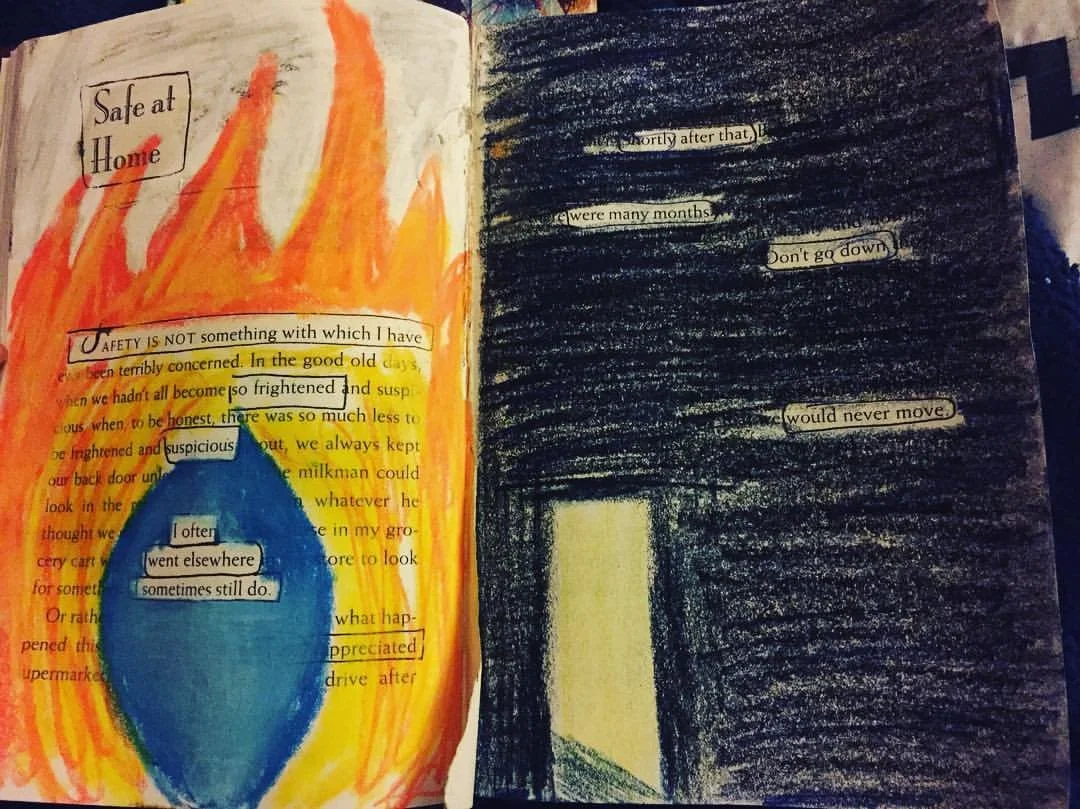
Art therapy is a master's-level mental health profession that uses the creative process, drawing, painting, collage, sculpture, and more, alongside psychological theory and the therapeutic relationship to support healing. It is evidence-based, clinically grounded, and increasingly in demand.
I like to think of it this way: art therapy is a process for when words are too heavy to speak.
There are experiences like trauma, grief, chronic shame, things that happened before you had language for them; that talking alone cannot always reach. When Bessel van der Kolk discovered that Broca's area of the brain (responsible for speech) actually shuts down during traumatic events, it changed how we think about healing. It means that for some experiences, words are not just hard to find, they are neurologically unavailable.
Art gives us another way in.
What Happens in an Art Therapy Session
I often tell new clients: trust your hands. Your brain already knows what it needs to do. It's your eyes that will tell you later when we pause to look.
In an art therapy session, I might invite you to draw something not because the finished image matters, but because the process of making it will tell us both something important. I watch your body language as you create. I notice when your breathing shifts. I observe what materials you gravitate toward and which ones you avoid. The art becomes a conversation between you and the parts of yourself that don't have words yet.
We don't rush to finish. We pause. We look. We wonder together about what you made and what it might mean.
Art therapy can:
Improve cognitive and sensory functioning
Build emotional resilience
Boost self-esteem
Help process traumatic experiences in a safer, more contained way
Offer a language when words aren't enough
Activate both hemispheres of the brain simultaneously — the analytical and the intuitive — in a way that talk therapy alone cannot
Do You Have to Be "Good at Art"?
No. Truly, no.
The question of artistic skill is one of the most common things people ask me, and my answer is always the same: you are already good at art. Art therapy is about the process, the language art provides, and the opportunity to express what's inside you. Whatever you create is meaningful not because it looks a certain way, but because it came from you.
Some of the most powerful art therapy moments I've witnessed have come from a scribble on a piece of paper, a collage made from magazine clippings, or a single color chosen because it "just felt right."
Who Benefits from Art Therapy?
Everyone. But in particular, art therapy tends to be deeply effective for people who:
Have experienced trauma, complex PTSD, or childhood wounds
Find that traditional talk therapy leaves something feeling unfinished
Carry things in their body — tension, anxiety, shutdown — that words haven't been able to touch
Feel like they don't have the right words for what they've been through
Are drawn to healing that honors intuition, creativity, and the non-verbal parts of themselves
Art Therapy at Painted Willow Healing
I am a Licensed Professional Counselor and Registered Art Therapist serving clients throughout Pennsylvania via telehealth. I completed my Master's in Art Therapy with a Specialization in Counseling from Seton Hill University, and I have spent years working with trauma survivors, using art as one of many tools to help people access healing that goes deeper than symptom management.
At Painted Willow Healing, art therapy is woven into a larger integrative approach that also includes EMDR, somatic work, and trauma-informed care. You don't have to do art in every session but when words aren't enough, the option is there.
If you're curious about what art therapy might look like for you, I'd love to connect. I offer a free consultation for new clients, and I accept most major insurance plans.
Ready to start? Reach out at kristin@paintedwillowhealing.com or call (724) 315-7805.
Kristin Riding, LPC, ATR, is a trauma therapist and registered art therapist offering telehealth therapy throughout Pennsylvania. She specializes in trauma, PTSD, anxiety, burnout, and integrative healing at Painted Willow Healing.